

Trending Now
- “Why has no action been taken in the matters involving Deputy Speaker Ravishankar and Kallakurichi MLA Arul Vignesh?” – NTK coordinator Seeman
- “Is Epstein a victim? Is Gem Veeramani a victim? Is there no protection even for the Collector? What is the TVK Govt trying to cover up?” – Selvaperunthagai
- “My phone contains evidence regarding the PM’s foreign connections. PM Modi is tapping my phone because I have this evidence.” – Alleged Rahul Gandhi
- “The Karnataka CM has once again started speaking strongly about constructing the Mekedatu dam. The TN Govt should not remain silent any longer.” – M.K.Stalin
Coimbatore


`Rain Man’ showers sustainable living style in dry Bengaluru

 April 14, 2017
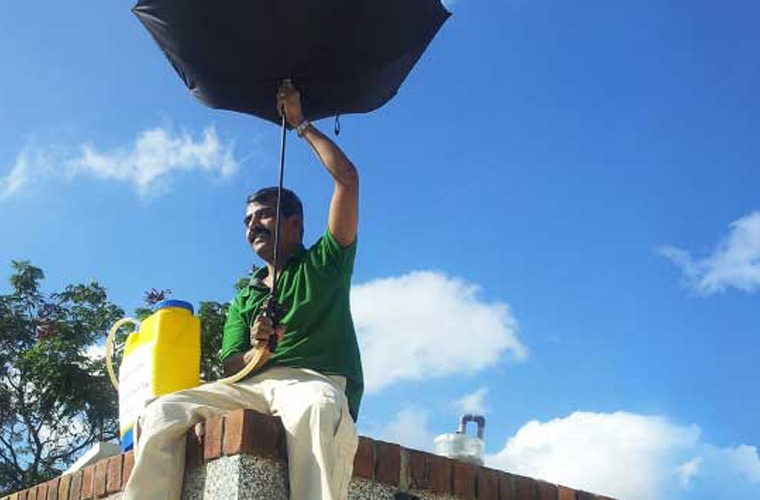

Bengaluru: Summer is here and Bengaluru is gearing up for another dry season. Water woes persist. But `Rain Man’ can do wonders with water harvesting and embracing sustainable living.
A.R. Shivakumar, Principal Scientific Officer, KSCST, IISC, aka our very own Rain Man from Bengaluru hasn’t paid water bill for the past 22 years. He looks to nature for his water needs and is happy storing rain water for his use.
It was a fight with the tenant for water that prompted him to this new act. “One day, we had a house full of guests, and there was not a drop of water. Mustering great courage, I decided to close the valve on the ground floor so that we could get some water! But my peace of mind was short lived as the ground-floor tenant came thundering up in rage. The incident left me shaken. Could there be a solution to such water woes,” recalls Shivakumar.
“Around the same time, I decided to buy a plot in Vijayanagar. It was a 40x60ft where the foundation for ‘Sourabha’ was laid. I began to experiment with rain water harvesting. ‘Sourabha’, depends on harvested rain for all its water needs. Apart from the electricity charges required to pump water, there have been no other recurring expenses associated with rainwater harvesting. We use 80 units of electricity and this includes the power used to pump water. We’ve incorporated a lot of sustainable practices, and this ensures that power is conserved. We’ve also used technology that conserves energy,” he adds.
His house is an inspiration and a great example of eco-friendly existence. Clouds provide rain water for all the water needs (24X7), including drinking water. He treats rainwater with a silver sheet making it zero bacteria and fit for drinking. Sun gives light, heat, warmth and energy to hundreds of plants in and around Sourabha. And if you are thinking of a tedious process, he assures it is not difficult to harvest water. “There are simple steps involved in harvesting rainwater from a house roof,” he says.
Step one: Select down water pipes carrying most of rainwater from your roof.
Step two: Inter connect these pipes.
Step three: Attach a rainwater filter at the end.
Step four: Connect the filtered water outlet of the filter to your underground sump/tank.