

Trending Now
- “SIR created a three-cornered contest in TN. Leaders opposed to the BJP were deliberately defeated. SIR could be a reason for TVK’s victory.” – Thirumavalavan
- “The by-election is proceeding without much excitement. It was only the by-election campaign that was intense. The interest and enthusiasm seen during the General Election are missing among the people.” – Tamilisai Soundararajan
- “How will this ‘Reels CM’ justify the fascist atrocities committed against the nurses?” – AIADMK General Secretary EPS
- “The police have brutally attacked nurses who were protesting to press for their demands. What do you call attacking children? ‘Thaimaaman Lathi-Charge’ Scheme?” – Udhayanidhi Stalin
- Sourav Ganguly is appointed as the Head Coach of Delhi Capitals
Coimbatore


Gandhian Principles Key to Protecting Democracy and Building an Inclusive India: Kumaraguru Institutions Chairman

 October 9, 2026
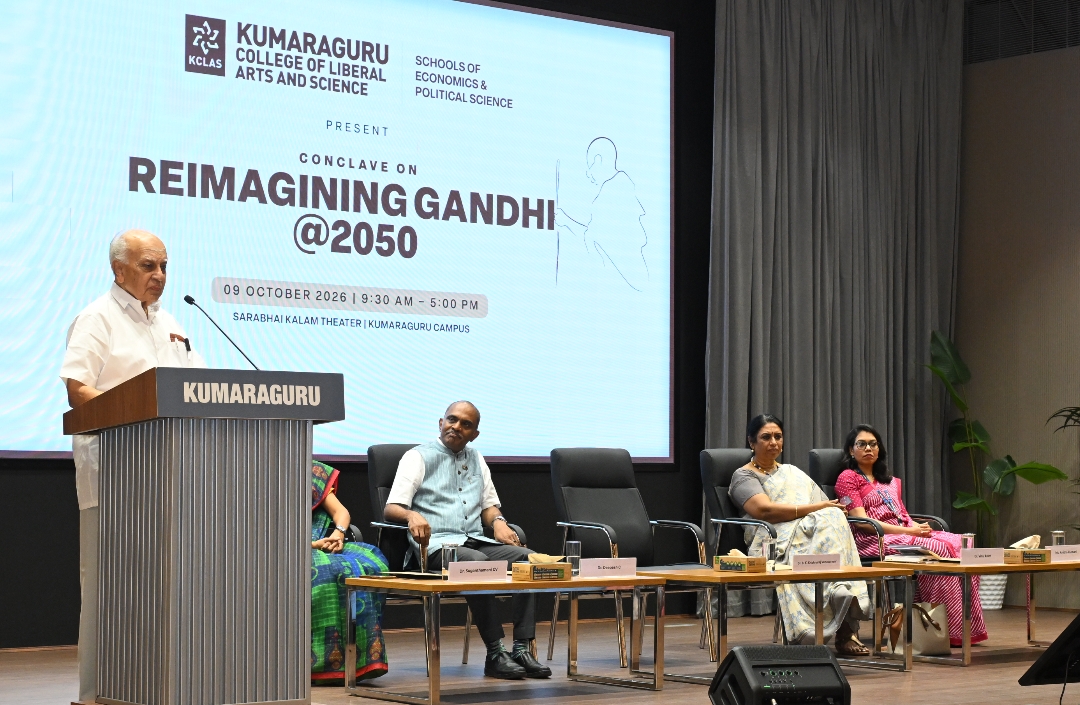

Gandhian principles remain vital to protecting democracy, upholding the Constitution and building an inclusive and sustainable India, said Dr. B. K. Krishnaraj Vanavarayar, Chairman of Kumaraguru Institutions.
He was delivering the presidential address at the conclave titled “Reimagining Gandhi @2050: Sustainable Future Through Gandhian Thought and Transformative Economic Practices,” organised by the Schools of Economics and Political Science at Kumaraguru College of Liberal Arts and Science (KCLAS).
Dr.Vanavarayar outlined five key priorities for contemporary India: safeguarding freedom and democracy, upholding constitutional values, preserving the country’s pluralistic character, promoting inclusive and participatory nation-building, and protecting fundamental human values such as love and compassion.
Emphasising that freedom and democracy were achieved through a prolonged struggle, he cautioned that these values should never be taken for granted. He also highlighted the importance of respecting India’s diversity and strengthening constitutional principles.
Explaining the relevance of Gandhian thought to modern economics, he advocated an approach centred on creating wealth through ethical means, ensuring its equitable distribution and pursuing economic development without harming nature. He said economic progress should prioritise human well-being, environmental sustainability, lasting peace and happiness rather than focusing solely on growth.
Contrasting the Gandhian philosophy with the notion of survival of the fittest, he stressed the need to create a society in which everyone has the opportunity to survive, develop and prosper. He urged economists and policymakers to place equity and social responsibility at the heart of development strategies.
He also encouraged scholars and researchers attending the conclave to connect Gandhian philosophy with contemporary political, economic and social challenges, stressing that academic discussions should lead to practical solutions.
The conclave brought together diverse perspectives on Gandhian thought, economics, political science, peace and sustainability. Discussions explored the continued relevance of concepts such as Swaraj, Sarvodaya, non-violence and ethical economics in shaping a more equitable and sustainable future.