

Trending Now
- “Vijay will become the PM in 2029.” – TVK MLA Kanimozhi Santhosh (Covai’s Kavundampalayam constituency)
- “If Vijay becomes Prime Minister, Parliament itself will become foolish.” – TTV Dhinakaran
- NPCI reports that 2,451 crore UPI transactions were carried out in August.
- Singai Ramachandran, who recently left the AIADMK and joined TVK, has been appointed as the CEO of Startup Tamil Nadu.
Coimbatore


Mandala art – reflection of our soul

 February 9, 2017
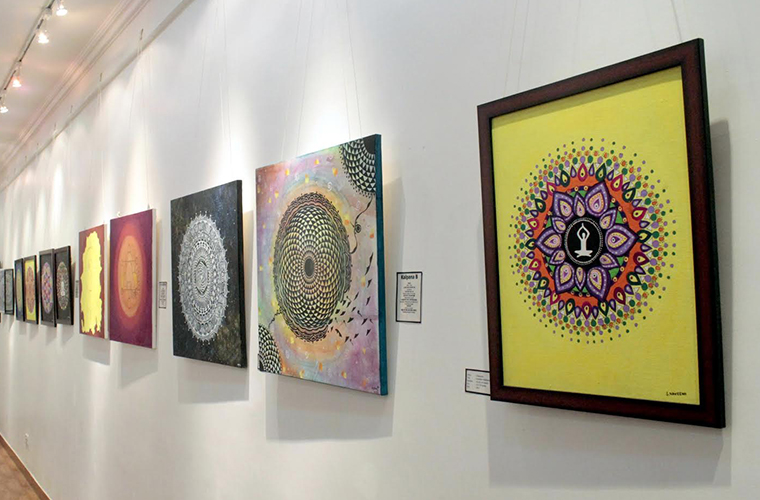

Our galaxy, the planets, the cells in the human body and other living beings – are all in the shape of the Mandala.
Mandala means ‘circle’ in Sanskrit, which represents wholeness. According to those who practise it, Mandala art existed from the beginning of the universe.
Rig Veda informs that the basic form of most mandalas is a square with four gates containing a circle with a centre point. Each gate is in the general shape of a T. Mandalas often exhibit radial balance.
Mandala designs have also been used as architectural models for some shrines, including the Sanchi Stupa in MP, revered as the site of the Buddha’s enlightenment. The structure consists of a massive 50-feet-high dome in which resides a sacred relic of the Buddha. The dome is circled by a walkway. Outside the walkway four walls form a square entered through elaborately carved stone gates.
C.V Rajan, one of artists who is exhibiting his Mandala paintings at Jenny Residency, says, “Mandala art basically represents what is going in our subconscious mind. There is always a central point or focus which radiates into a symmetrical design.” In his paintings, the centric point is bright yellow in colour representing enlightenment.
“It is a sacred geometrical art bound in a circle, just like the yin yang Chinese symbol that represents good and bad. It is even used as a therapy in foreign countries,” says Pavithra Kannan, a freelance artist who specialises in cubism and optical art.
S. Sindhu, a painter as well as a Bharatanatyam dancer says, “In foreign countries, post-traumatic stress patients are recommended to do the art as part of their therapy. Whenever I make this art it brings peace and calmness to me, and the concentration level is also very high.”