

Trending Now
- “The by-election should be the beginning of the downfall of the TVK Govt.” – Leader of the Opposition Udhayanidhi Stalin
- “DMDK will remain with the DMK. I told brother Stalin that there will be 100% cooperation in the by-election. I will definitely campaign.” – DMDK General Secretary Premalatha (interview)
- “Stalin did not extend greetings on Vinayagar Chaturthi; that is why he lost the election.” – criticises L.Murugan
- MoU Worth Rs.11,000 crore signed in London in the presence of CM Vijay.
Coimbatore


World Environment Day: Cauvery Calling Launches Plantation Drive for 1.2 Crore Trees Across Tamil Nadu

 June 5, 2026
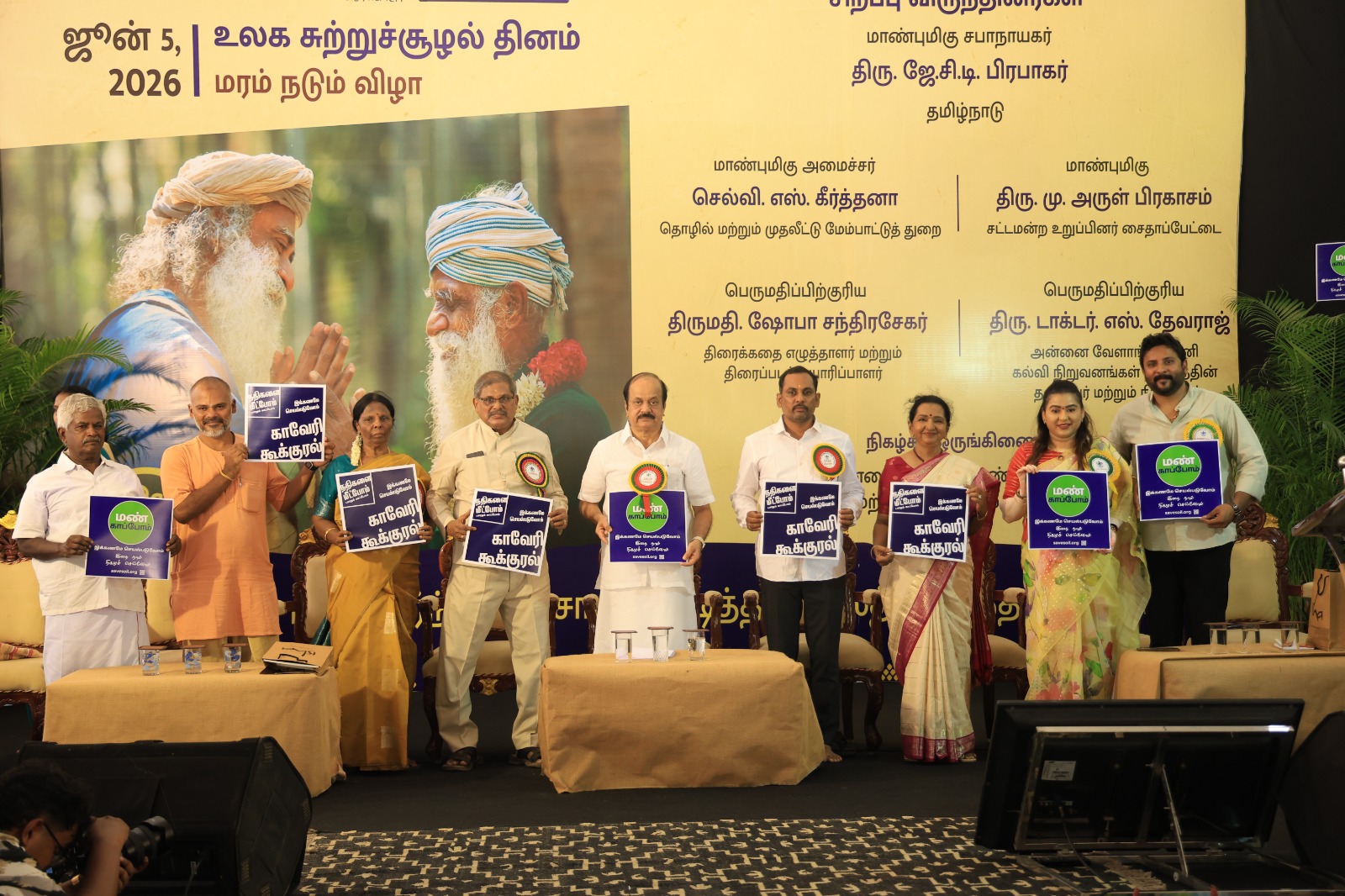
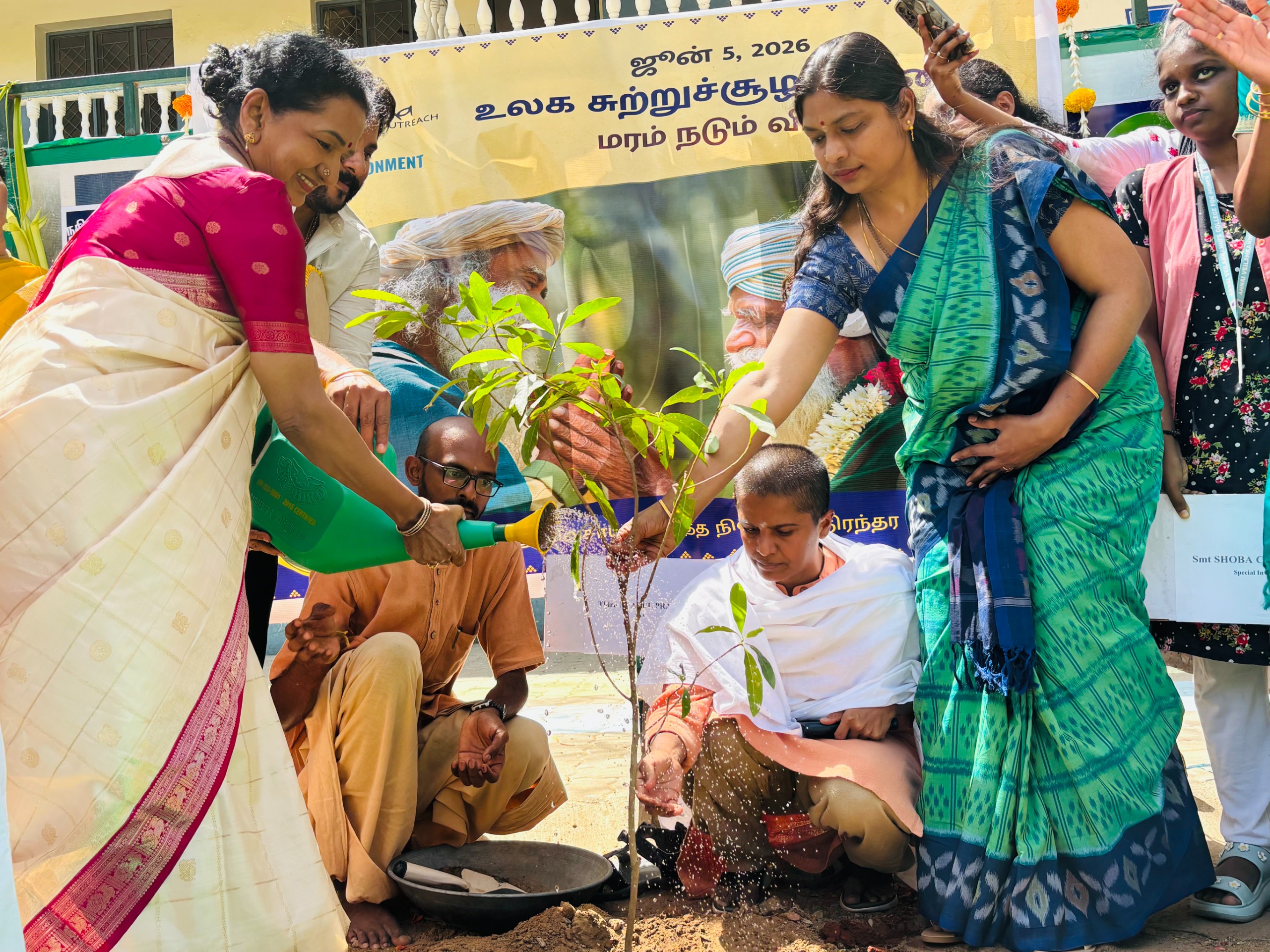

Inaugurated by Speaker JCD Prabhakar in Chennai and Chief Minister Rangasamy in Puducherry
Chennai, June 5: Sadhguru’s Cauvery Calling movement has set a target of planting 1.2 crore (12 million) trees in 2026–27. Marking World Environment Day, the annual plantation drive was inaugurated today at more than 140 locations across Tamil Nadu. To date, the movement has facilitated the planting of 13.4 crore (134 million) trees and supported 2.6 lakh farmers in transitioning to tree-based agriculture.
At the inauguration held at Annai Velankanni College, Saidapet, Chennai, Speaker JCD Prabhakar, Saidapet MLA Arul Prakasam, film producer and musician Shoba Chandrasekhar participated as chief guests and launched the plantation activities by planting saplings. In Puducherry, Chief Minister N. Rangasamy inaugurated the tree-planting drive.
Addressing the gathering, Speaker JCD Prabhakar said, “If we are to attain a healthy and prosperous life, a healthy environment is essential. Through its various initiatives, Isha is making people aware of this reality. While the Isha Yoga Center is dedicated to fostering inner transformation, it is equally fitting that it celebrates World Environment Day and promotes tree-based agriculture through movements like Cauvery Calling.
Speaking about Tamil Nadu’s environmental priorities, he said, “Tamil Nadu is blessed with abundant natural resources. Expanding forest cover will help increase rainfall and agricultural productivity. In line with this, the Chief Minister has taken decisive steps to curb illegal mineral extraction and protect natural resources. He has committed to increasing the state’s forest cover to 33 percent by 2031.”
He added that the government is implementing long-term measures to prevent industrial effluents from entering water bodies, reduce air pollution, establish green parks along riverbanks, protect mangrove forests, and rejuvenate the Cooum River.
Speaking on the occasion, Shoba Chandrasekhar said, “We have gathered here not to speak about human beings, but to express gratitude to the soil and the trees. We must realize how mistaken we are when we use expressions that demean soil and trees. If we can live in a way that is as useful to others as the soil and the trees are, that alone is enough.”
Referring to the importance of protecting nature, she added, “Poet Khalil Gibran described trees as ‘poems that the earth writes upon the sky.’ Looking at the trees around us, we can see how true that is. We have no right to destroy or uproot such beautiful poems. My heartfelt congratulations to Sadhguru for launching the Save Soil movement and creating global awareness and meaningful action for soil conservation.”
Highlighting the impact of the movement, she said, “Save Soil–Cauvery Calling has achieved the remarkable milestone of planting 13.4 crore trees on farmlands and enabling 2.6 lakh farmers to transition to tree-based agriculture. The Cauvery Calling nursery in Cuddalore has the capacity to produce around 85 lakh saplings annually. It is one of Asia’s largest nurseries and the largest nursery fully managed by women. My appreciation goes to all the volunteers who have made this possible.”
As part of the World Environment Day celebrations, launch events were conducted at more than 140 locations across Tamil Nadu. Over 1,00,000 saplings were planted on farmlands, initiating tree-based agriculture across 317 acres. MLAs, district officials, and other dignitaries participated in the district-level events held throughout the state.
The plantation drive aligns with this year’s World Environment Day theme, “Inspired by Nature. For Climate. For Our Future.”
Envisioned by Sadhguru, the Cauvery Calling movement seeks to rejuvenate the Cauvery River while enhancing farmers’ incomes through large-scale adoption of tree-based agriculture across the river basin. The movement has received accreditation from both the United Nations Convention to Combat Desertification (UNCCD) and the United Nations Environment Programme (UNEP).
Under tree-based agriculture, farmers cultivate commercially valuable trees alongside conventional crops, improving soil fertility, water retention, biodiversity, and farm profitability. The model is increasingly being adopted as a sustainable solution that benefits both the environment and rural livelihoods.
Farmers can increase their incomes by three to five times through tree-based agriculture. To support this transition, Isha nurseries provide saplings of valuable timber species such as teak, red sandalwood, sandalwood, vengai, malai vembu, mahogany, and rosewood, along with income-generating crops suitable for plains regions such as pepper, avocado, and nutmeg, at highly subsidized prices.
The Cuddalore nursery, Asia’s largest single-site nursery and the largest fully women-managed nursery, produces 85 lakh saplings annually, while the Tiruvannamalai nursery produces 15 lakh saplings annually. Together, these nurseries supply saplings to 45 distribution centers in Tamil Nadu and 8 distribution centers in Karnataka, playing a key role in expanding tree-based agriculture.
In addition, the Cauvery Calling movement provides free technical guidance on plantation and maintenance. Field teams directly visit farms to advise farmers on suitable tree species, water and weed management, intercropping practices, and other aspects essential for the successful adoption of tree-based agriculture.